Research Article no_lock Open Access no_lock Open Peer Review

School Mask Mandates and Student SARS-CoV-2 Infections: Evidence from a Natural Experiment of Neighboring K-12 Districts in North Dakota, USA

  • Neeraj Sood
  • Shannon Heick
  • Josh Stevenson
  • Tracy Beth Høeg

Submitted: Dec 22, 2024| Published: Jan 30, 2025 | DOI: https://doi.org/10.70542/rcj-japh-art-4abgc4

100

1.4k


Citations

Views

Downloads

Comments

Views

100

1.4k


Citations

Views

Downloads

Comments

Views

search_icon
search_icon Abstract
search_icon 1 - Introduction
search_icon 2 - Methods
search_icon 3 - Results
search_icon 4 - Discussion
search_icon References
Abstract
1 - Introduction
2 - Methods
3 - Results
4 - Discussion
References
Article search_icon Tools search_icon
search_icon
search_icon Abstract
search_icon 1 - Introduction
search_icon 2 - Methods
search_icon 3 - Results
search_icon 4 - Discussion
search_icon References
Peer Reviews
Authors
Reader Comments
Supplemental Materials

Abstract

Objective: To assess student COVID-19 case rates in two neighboring kindergarten-12th grade (K-12) school districts while one district had a mask mandate and the other did not and then while both did not have a mandate.
 
Design: Prospective natural experiment with partial crossover period to identify differences in baseline COVID-19 case rates while district mask polices were the same. Setting: Two adjacent school districts in Fargo, ND, during the 2021-2022 academic year. Study population: K-12 students in West Fargo and Fargo Public School districts. Intervention: Mask mandates for students and staff in Fargo Public School districts from 8/26/2021 through 1/17/2022.
 
Main outcome measures: COVID-19 student case rates and incidence rate ratio (IRR) for case rates between the districts while the districts had different and the same masking polices. Results: District student populations were not significantly different with respect to demographics, socioeconomic status or testing strategies. We observed no significant difference between student case rates while the districts had differing masking policies (IRR 0.99; 95% CI: 0.92 to 1.07) nor while they had the same mask policies (IRR 1.04; 95% CI: 0.92 to 1.16). The IRRs across the two periods were also not significantly different (p = 0.40). Based on an incidence rate of 13%, we had 80% power to detect a 1.2 percentage point difference in incidence.
 
Conclusion: Primary and secondary school mask mandates of the nature and setting described in the Fargo public schools were not found to be associated with lower student COVID-19 case rates.
 
Key words: COVID-19, SARS-CoV-2, mask mandates, natural experiment, prospective observational study, partial crossover
 
Disclosures, Funding & Conflicts of Interest:
None
 
Affiliations:
Neeraj Sood, MD, Sol Price School of Public Policy, University of Southern California, CA, USA
Shannon Heick, MSW, LCSW, Independent, Fargo, ND, USA
Josh Stevenson, Truth in Data, LLC, USA
Tracy Beth Høeg, MD, PhD, Sloan School of Management, Massachusetts Institute of Technology, Cambridge, MA, USA
 
Correspondence:
Neeraj Sood, Professor, University of Southern California University Park Campus, Verna and Peter Dauterive Hall, 635 Downey Way, Los Angeles CA 90089
(213) 821-7949
 
Submitted 12/22/2024

1 - Introduction

School districts across the world implemented mask mandates for children in the hope of reducing COVID-19 transmission, but the impact of school-based mask mandates on COVID-19 transmission in children continues to be a topic of debate. While observational studies of school mask mandates have had conflicting results,1,2,3,4,5,6,7,8,9 randomized studies have failed to detect an impact of masking for COVID-19 on participants under 50 years of age and the trial from Bangladesh10 reporting modest efficacy of surgical masking on those over 50 years has important biases which render this finding uncertain.11 Pooled results from randomized studies of medical or surgical grade masks for respiratory viruses in the community have been negative, though the level of certainty is low to moderate.12 Here we report the results of a prospective observational study of two large kindergarten-12th grade (K-12; corresponding to students ages 5-18 years) school districts in Cass County, North Dakota USA. Fargo Public Schools (FPS) and West Fargo Public Schools (WF) had differing mask policies in the fall of 2021 and the same policy in 2022. Our study takes advantage this unique situation to estimate the association between school mask mandates and student COVID-19 infections. The masks-mandated and masks-optional populations are comparable: their districts are adjacent to each other in Cass County, have similar student enrollment numbers, student demographics, COVID-19 mitigation policies and staff vaccination rates. At the start of the Fall 2021 semester, FPS mandated masks and WF did not.13 On January 17, 2022, FPS also moved to a mask optional policy,14 creating a unique natural experiment to study school-based mask mandates.


2 - Methods

The study was conceived in the summer of 2021 based on the knowledge that two adjacent school districts in Fargo North Dakota would be adopting different school masking policies. We obtained data on student enrollment, masking policies, masking compliance, demographic information (race/ethnicity and family income), and COVID-19 mitigation measures from district administrators and official school district websites. We obtained publicly available data on new student COVID-19 case rates in each school district from August 26, 2021, to March 2, 2022, from the North Dakota Department of Health (NDDOH) website.15 The state department of public health is the official body responsible for COVID-19 surveillance and reporting.16,17 The raw data used for our analysis are available at the following url: https://github.com/tracybethhoeg/North-Dakota-Mask-Study.18 County and district level vaccination rates were obtained from the NDDOH. We determined the COVID-19 student case rates and incidence rate ratio (IRR) as well as 95% confidence intervals (CI) for case rates between the districts, both while FPS had a mask mandate and WF did not and then when FPS dropped their mandate on January 17, 2022, after which both districts had mask-optional policies. In both districts, mask-optional policies meant masks were not required for students or staff in any situation on school/district premises but were required on school busses and any school-related public transportation, due to the federal mandate.13,14
 
We opted to extend our initial study period beyond the Fall semester in order to include the time period where both districts had no mask mandate to identify differences in case rates unrelated to masking policy. In particular, the IRR (IRR1) for the period between Fall 2021 and Jan 17, 2022 captures differences in COVID-19 infections between FPS and WP for two reasons: (a) differences in mask policies, (b) other differences in background characteristics across these districts such as average class size or fraction of low-income students. The IRR (IRR2) after Jan 17, 2022 captures differences in COVID-19 infections between FPS and WP due to differences in background characteristics only as the two districts had identical mask policies during this time period. Therefore, comparing the IRRs across two periods allows 
us to estimate the potential effect of mask mandates on student COVID-19 infection
rates. In particular, a finding that IRR1 is smaller than IRR2 would suggest that school mask mandates had a protective effect of reducing COVID-19 infections after controlling for differences in background characteristics across districts.
 
According to the NIH’s Human Subjects Research Decision Tool (https://grants.nih.gov/policy/humansubjects/hs-decision.htm), this study was IRB exempt. We used Stata 2021 Version 17 for the main and sensitivity analyses. A post-hoc power calculation was performed using ClinCalc.19 Staff rate vaccination confidence intervals were calculated using University of California Sample Size Calculators.20 Our report follows the STROBE reporting guidelines for observational studies.21
 

Sensitivity Analysis

We performed a sensitivity analysis excluding the period of time during winter break when children were outside of school to minimize the impact of cases acquired in the community over the break in our analysis. In particular, both school districts had winter break from December 23 to January 2. We excluded cases from December 25 to January 6 to allow for a three-day lag from exposure to diagnosis of a case. We also performed the sensitivity analysis to allow for a seven-day lag.

3 - Results

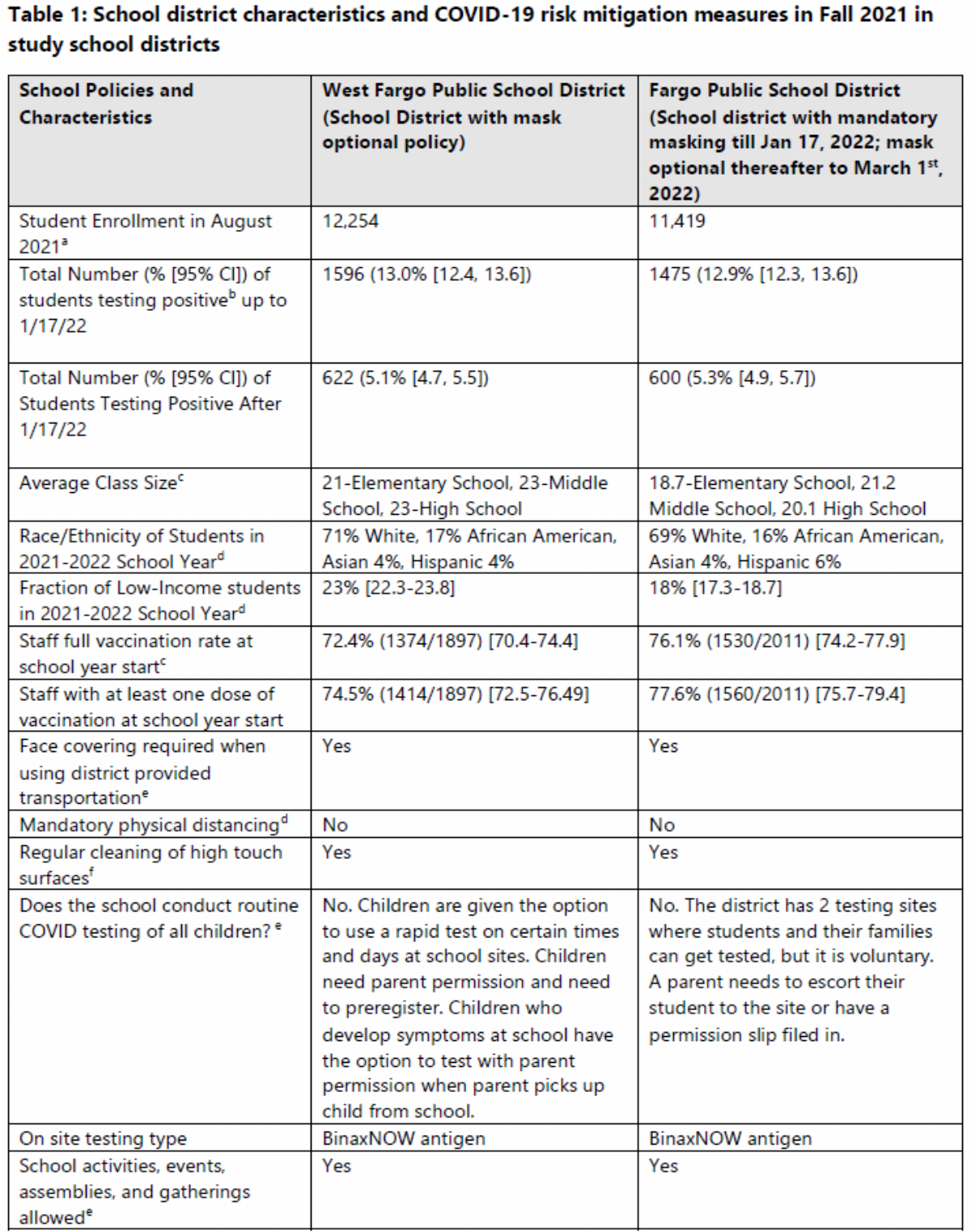
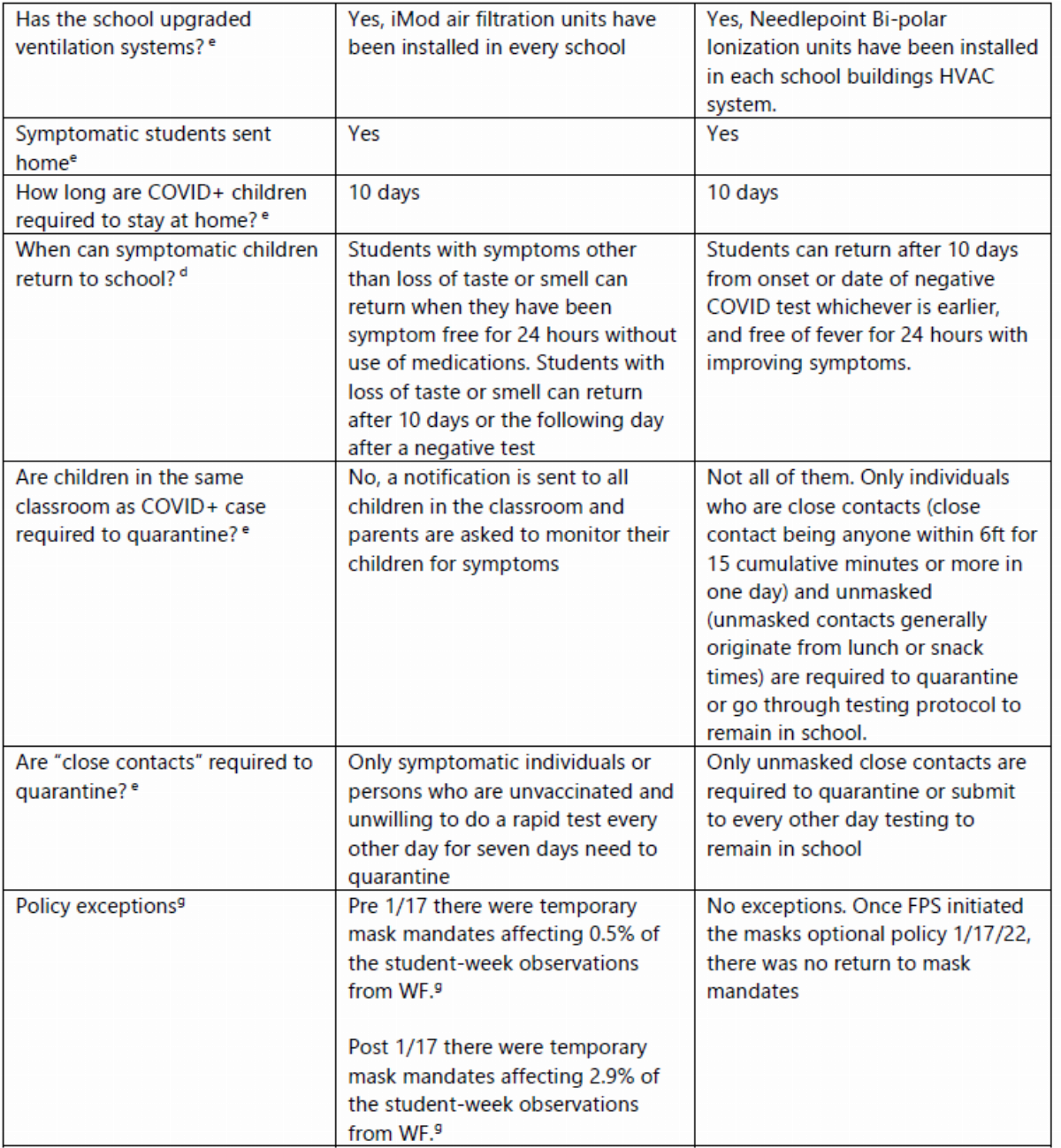
Table 1 shows school characteristics, total number of positive student tests and the COVID-19 risk mitigation measures implemented by each district. Both school districts had similar COVID-19 mitigation policies, although FPS had more stringent rules for quarantining close contacts. WF also had higher percentages of low-income and minority students. Staff vaccination rates by district are shown in Table 1. FPS had a slightly higher, though not significantly so, staff full vaccination rate at 76.1% vs 72.4% in WF. Child vaccination rates were not available at the district level through NDDOH. As of August 29th, the county level vaccination rate of 5-11-year-olds was 0% and for 12-18-year-olds was 39.8% and this increased to 28.1% and 53.4% respectively by February 29th.22 Vaccination types at the county level through February 29th, 2022 was 76.6% Pfizer-BioNTech, 19.2% Moderna and 4.2% Janssen.21 Only Pfizer-BioNTech was available to children under 18 years during the study period.
 
Notes: (a)Information from school district websites. WFPS: https://www.west-fargo.k12.nd.us/site/default.aspx?PageType=3&DomainID=22&ModuleInstanceID=11253&ViewID=644146EE88-D30C-497E-9316-3F8874B3E108&RenderLoc=0&FlexDataID=24239&PageID=37 accessed March 31, 2022. FPS: https://www.fargo.k12.nd.us/page/365 accessed March 31, 2022.
(b)Students only required one positive test to be counted as a case and, per CDC guidelines, a student would not be counted as positive twice within a 90-day period. This was based on https://www.west-fargo.k12.nd.us/cms/lib/ND02203445/Centricity/Domain/2935/Positive%20Cases%20and%20Close%20Contacts.pdf and communication with district staff.
(c)Information from communication with school administrators.
(d)Information from official portal for North Dakota state government. WFPS: https://insights.nd.gov/Education/District/EnrollmentDemographics/09006 accessed March 31, 2022. FPS: https://insights.nd.gov/Education/District/EnrollmentDemographics/09001 accessed March 31, 2022. (e)Information from school COVID-19 protocols. WFPS: https://www.west-fargo.k12.nd.us/cms/lib/ND02203445/Centricity/Domain/2935/COVID%20Health%20and%20Safety%20Protocols%202021-22.pdf accessed March 31, 2022. FPS: https://drive.google.com/file/d/1qyn7DNvCnSuKszHqM8C8BTAixmnCbToS/view accessed March 31, 2022. (f)Personal communication with Brooks Harbor Principle.
(g)Exceptions were based on district recommendations and involved individual school input as described here: https://www.west- fargo.k12.nd.us/cms/lib/ND02203445/Centricity/Domain/2935/COVID%20Health%20and%20Sa fety%20Protocols%202021-22.pdf. Personal communication with Executive Assistant to the Superintendent and School Board Fargo Public Schools. Details on Schools that reinstated mask mandates with student population in parentheses: Brooks Harbor Elementary (493) 10/25-11/2, Legacy Elementary (481)11/30-12/7 and 1/19-1/28, Horace Elementary (305) 1/20-1/28, with virtual learning from 1/21-1/25, Westside Elementary (411) 1/21-1/29, LE Berger Elementary (372) 1/24-1/30, Harwood Elementary (130) 1/24-2/2, Community High School (61) 1/25-2/3, Transition Academy (30) 1/28-2/4.
 

FPS had mandatory student and staff masking policy prior to Jan 17, 2022 and dropped the policy thereafter. WF did not have mandatory student or staff masking policy throughout the duration of the study. Reported mask adherence rate from WF was 5% or less via personal communication23 with the exception of limited number of WF schools, which adopted brief (typically around one academic week) mask mandates affecting 0.5% of the student observations prior to Jan 17, 2022 and 2.9% of the observations post Jan 17, 2022 (See “Policy exceptions” in Table 1).
 
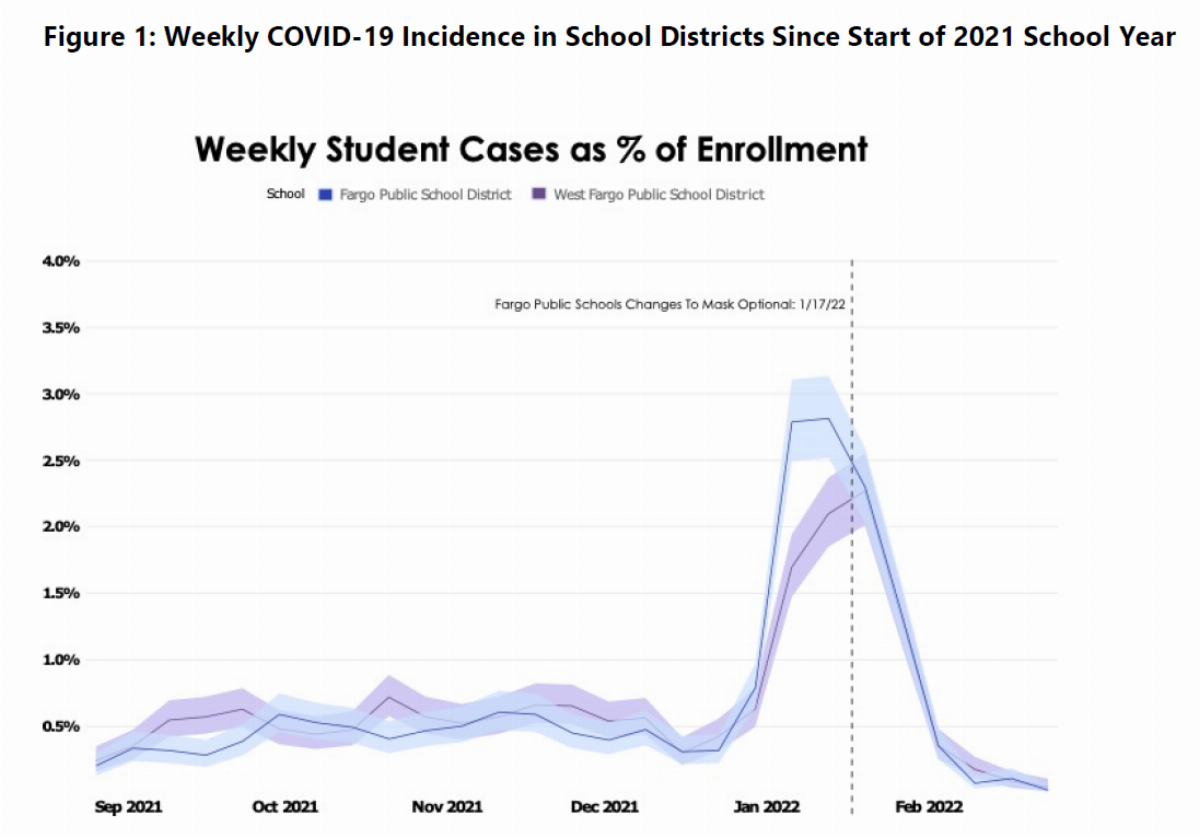
Figure 1 shows that overall trends in COVID-19 incidence among students were similar in the two districts even when they had different masking policies. From August 26, 2021, to January 17, 2022, cumulative incidence in the mask compulsory school district was almost identical to cumulative incidence in the mask-optional district (WF: 1596/12,254 [13.0%; 95% CI: 12.4, 13.6]); FPS: 1475/11,419 [12.9% 95% CI: 12.3, 13.6%]). IRR 0.99; 95% CI: 0.92, 1.07). From January 17 to February 28, 2022, when both districts had mask-optional policies, case rates were also not significantly different (WF: 622/12,254 [5.1%; 95% CI: 4.7, 5.5]; FPS: 600/11,419 [5.3%; 95% CI: 4.9, 5.7]). IRR 1.04; 95% CI: 0.92, 1.16).
 
Notes: Shaded region represents 95% confidence intervals. Information on new student COVID-19 cases from North Dakota Department of Health website available at https://web.archive.org/web/20220125093234/https://www.health.nd.gov/k-12-school-dashboard WFPS: https://www.west-fargo.k12.nd.us/site/default.aspx?PageType=3&DomainID=22&ModuleInstanceID=11253&ViewID=6446EE88-D30C-497E-9316-3F8874B3E108&RenderLoc=0&FlexDataID=24239&PageID=37 accessed March 31, 2022. FPS: https://www.fargo.k12.nd.us/page/365 accessed March 31, 2022. The IRRs across the two periods were also not statistically significantly different (p value = 0.40). Based on an incidence rate of 13%, we had 80% power to detect a 1.2 percentage point difference in incidence or an IRR of 0.91 between the districts.


Results from the sensitivity analysis removing days related to school vacation allowing for three- and seven-day exposure to diagnosis lag showed similar results. IRR during the period when FPS and WF had different masking policies was not statistically different from one [IRR 0.98; 95% CI 0.91 to 1.06]. The IRRs across the two periods were also not statistically significantly different (p value = 0.45).

4 - Discussion

This study found that K-12 school mask mandates were not associated with significantly lower COVID-19 student case rates. This is consistent with adult randomized data on community cloth masking,10 multiple observational studies of school mask mandates,1,2,3,6,7 a systematic review of child mask mandates24 and a systematic review of randomized controlled trials of medical or respirator masking for respiratory illness prevention.12 While some observational studies have reported a negative association between school mask mandates and SARS-CoV-2 cases,4,5,8,25 a number of these have faced critique for not being robust to expanding the sample size7,26 to alternate methods for analyzing the data7,26 or for clear ecological bias/insufficiently adjusted confounding.26,27
 
The main strengths of our study are 1) the striking similarities between the two districts and 2) the unique opportunity for a crossover period within the study. First, similarities of the two K-12 districts include size, adjacent location within the same county, similar demographics, and COVID-19 policies beyond masking. Second, the partial crossover design (similar to a difference-in-difference design) with the mask mandate district (FPS) dropping its mandate during the study period, served as a control for time invariant observable or unobservable differences in COVID-19 policies or other background characteristics across the two districts. Any significant confounding created by differences in background characteristics such as average class size or fraction low-income population should have been apparent in the crossover period, but no difference was observed.
 
Our study had 80% power to detect a 1.2 percentage point (IRR 0.91) difference in incidence between the districts, so if we failed to detect a benefit of mask mandates, that benefit would have been modest. An additional strength of this study is it includes a relatively long study period with data from both the delta and omicron waves. There was a large spike of cases during the omicron wave, part of which occurred over the winter break. We performed two sensitivity analyses removing the winter break period and failed to find any difference in our outcome.
 
The study also has limitations. We did not have information on the number of tests performed by each school district. However, in both districts rapid testing was available but was voluntary. There was a discrepancy in quarantine policies where WF required unvaccinated students to test every other day for 7 days, FPS only required this of unmasked students, which may have increased the testing rate at WF in relation to FPS owing to a higher likelihood that a student was unvaccinated at WF than unmasked at FPS, but this would have given a false appearance of higher cases in the unmasked district, but did not. Furthermore, if overall testing rate had been a major confounding variable, we should have seen a difference between the groups in the period of time when neither district had a mask mandate. Both districts upgraded their air ventilation systems for COVID-19, though had installed different types of units. A recent systematic review failed to find robust evidence of benefit of air filtration systems against respiratory infections28 though randomized data are still lacking. However, any confounding created by air filtration differences should have been apparent in the post-January 17th, 2022 period when both districts had the same mask policy.
 
Second, this study did not specifically evaluate in-school transmission and we were thus only able to look for correlation between mask mandates and overall student infection rates. We also did not have data on the types of masks being worn or on masking adherence rates in the two school districts; however, parents and administrators indicated via personal communication with SH, masking was near universal in the district with a mask mandate and 5% or less in the masks-optional district.23 This was thus not a study of mask effectiveness but of correlation between school mask mandates and student cases. We could not assess the effectiveness of a mask on a particular individual or evaluate different types of masks.
 
Third, we do not have information on severity of cases thus cannot evaluate if mask mandates were associated with disease severity. We are not able to control for community case rates among adults because these districts are within the same county and only county level case rates are reported. Although we found no association between school mask mandates and COVID-19 student cases, we are unable to determine if certain masks may offer protection in certain situations. For example, our findings may not be applicable to brief encounters and/or those with fitted N95 respirator masks.
 
Fourth, though our natural experiment design with a partial crossover period offered a unique way to detect the presence of relevant confounding variables, we are not able to entirely rule out the presence of confounding in our results. For example, we were unable to entirely rule the appearance of new or time-varying confounders, such as changes in testing rates or immunity levels occurring at or around the same time as the FPS mask policy change in January, 2022, which may have hidden evidence of prior confounding. Furthermore, a limited number of WF schools (0.5% of student-week observations) adopted temporary mask mandates in response to a rise in cases pre-January 17th (Table 1) and we are unable to say if masks prevented additional rises in case rates in these specific schools. Finally, WF and FPS students and staff regularly interacted in sport, extra-curricular and social activities and our study design did not permit us to isolate which transmission occurred within the school setting vs after school or on the weekends.
 
The results of our study are consistent with two other natural experiments of school mask mandates in children3,6 and the pooled results of randomized trials of masking in the community and healthcare setting to prevent respiratory viruses. Notably, the randomized trials included almost exclusively adults.12 Randomized trials in school settings have not been performed but could have minimized the opportunity for bias even further than the published natural experiments.
 
Masking recommendations for children have varied dramatically worldwide since 2020. The European CDC did not recommend masking for children under 12 years while the US CDC continues to recommend masking for children starting at two years in certain circumstances.29,30 Concerns about harm to children include, but are not limited to, detrimental effects on speech, comprehension, emotional health as well as physical discomfort and discouragement of physical activity and should be considered in the context of the current lack of high-quality evidence of benefit.24,30
 
In conclusion, school mask mandates were not found to be associated with significantly lower student SARS-CoV-2 case rates in our study. While randomized trials of masking in this setting have not been reported, the findings of our unique natural experiment are consistent with a growing body of scientific literature and should be taken into consideration and weighed with the potential harms and discomfort of masking in the educational setting.

References

1.

Oster E, Jack R, Halloran C, Schoof J, McLeod D. COVID-19 Mitigation Practices and COVID-19 Rates in Schools: Report on Data from Florida, New York and Massachusetts. medRxiv. 2021:2021.05.19.21257467.

2.

Gettings J, Czarnik M, Morris E, Haller E, Thompson-Paul AM, Rasberry C, et al. Mask use and ventilation improvements to reduce COVID-19 incidence in elementary schools—Georgia, November 16–December 11, 2020. Morbidity and Mortality Weekly Report. 2021;70(21):779.

3.

Coma E, Català M, Méndez-Boo L, Alonso S, Hermosilla E, Alvarez-Lacalle E, et al. Unravelling the role of the mandatory use of face covering masks for the control of SARS-CoV-2 in schools: a quasi-experimental study nested in a population-based cohort in Catalonia (Spain). Archives of disease in childhood. 2023;108(2):131-6.

4.

Jehn M, Mac McCullough J, Dale AP, Gue M, Eller B, Cullen T, et al. Association between K–12 school mask policies and school-associated COVID-19 outbreaks—Maricopa and Pima Counties, Arizona, July–August 2021. Morbidity and Mortality Weekly Report. 2021;70(39):1372.

5.

Boutzoukas AE, Zimmerman KO, Inkelas M, Brookhart MA, Benjamin Sr DK, Butteris S, et al. School masking policies and secondary SARS-CoV-2 transmission. Pediatrics. 2022;149(6):e2022056687.

6.

Juutinen A, Sarvikivi E, Laukkanen-Nevala P, Helve O. Face mask recommendations in schools did not impact COVID-19 incidence among 10–12-year-olds in Finland–joinpoint regression analysis. BMC Public Health. 2023;23(1):1-6.

7.

Chandra A, Høeg TB. Lack of correlation between school mask mandates and paediatric COVID-19 cases in a large cohort. Journal of Infection. 2022;85(6):671-5.

8.

Cowger TL, Murray EJ, Clarke J, Bassett MT, Ojikutu BO, Sánchez SM, et al. Lifting universal masking in schools—COVID-19 incidence among students and staff. New England Journal of Medicine. 2022;387(21):1935-46.

9.

Bundgaard H, Bundgaard JS, Raaschou-Pedersen DET, von Buchwald C, Todsen T, Norsk JB, et al. Effectiveness of adding a mask recommendation to other public health measures to prevent SARS-CoV-2 infection in Danish mask wearers: a randomized controlled trial. Annals of internal medicine. 2021;174(3):335-43.

10.

Abaluck J, Kwong LH, Styczynski A, Haque A, Kabir MA, Bates-Jefferys E, et al. Impact of community masking on COVID-19: A cluster-randomized trial in Bangladesh. Science.
2022;375(6577):eabi9069.

11.

Chikina M, Pegden W, Recht B. Re-analysis on the statistical sampling biases of a mask promotion trial in Bangladesh: a statistical replication. Trials. 2022;23(1):1-5.

12.

Jefferson T, Dooley L, Ferroni E, Al-Ansary LA, van Driel ML, Bawazeer GA, et al. Physical interventions to interrupt or reduce the spread of respiratory viruses. Cochrane database of systematic reviews. 2023(1).

13.

West Fargo Public Schools. Health and Safety Protocols 2021-2022.; 2021 [Avaiable from https://www.west-
16
fargo.k12.nd.us/cms/lib/ND02203445/Centricity/Domain/2935/COVID%20Health%20and%20Safety%20Protocols%202021-22.pdf (Accessed 16 December 2023)].

14.

Fargo Public Schools. 2021-2022 School Year Information. 2021 [Available from https://www.west-fargo.k12.nd.us/cms/lib/ND02203445/Centricity/Domain/2935/COVID%20Health%20and%20Safety%20Protocols%202021-22.pdf (Accessed 16 December 2023)].

15.

North Dakota Department of Health. North Dakota Department of Health K-12 Dashboard 2022 [Available from: https://web.archive.org/web/20220125093234/https://www.health.nd.gov/k-12-school-dashboard].

16.

State of North Dakota. Governor Doug Burgum Executive Order 2020-38. 2020.[Avialable from https://www.governor.nd.gov/sites/www/files/documents/Executive%20Order%202020-38%20FINAL.pdf (Accessed 19 December 2023)]

17.

North Dakota Department of Public Instruction and North Dakota Department of Health. North Dakota K-12 Smart Restart. 2020.[Available from https://www.nd.gov/dpi/sites/www/files/documents/Covid-19/NDK12restartguide.pdf]

18.

Sood N, Heick S, Stevenson J, Høeg TB. Data from School Mask Mandates and Student SARS-CoV-2 Infections: Evidence from a Natural Experiment of Neighboring K-12 Districts in North Dakota, USA https://github.com/tracybethhoeg/North-Dakota-Mask-Study. Digital Repository, June 18, 2022.

19.

SP K. Sample Size Calculator 2019 [Available from: https://clincalc.com/stats/samplesize.aspx/ (Accessed 12 June 2022)]

20.

Kohn MA SJ. Sample Size Calculators UCSF CTSI2023 [Available from: https://www.sample-size.net/ (Accessed 21 December 2023)].

21.

Von Elm E, Altman DG, Egger M, Pocock SJ, Gøtzsche PC, Vandenbroucke JP. The Strengthening the Reporting of Observational Studies in Epidemiology (STROBE) statement: guidelines for reporting observational studies. The Lancet. 2007;370(9596):1453-7.

22.

North Dakota Department of Health and Human Services. COVID-19 Vaccine Dashboard. [Available from: https://www.hhs.nd.gov/health/coronavirus/covid-19-vaccine-dashboard (Accessed 16 December 2023)].

23.

Heick S. Personal communication about masking adherence with parents and administrators. 2021.

24.

Sandlund J, Duriseti R, Ladhani SN, Stuart K, Noble J, Høeg TB. Child mask mandates for COVID-19: a systematic review. Archives of Disease in Childhood. 2023;36215.

25.

Budzyn SE, Panaggio MJ, Parks SE, Papazian M, Magid J, Eng M, et al. Pediatric COVID-19 cases in counties with and without school mask requirements—United States, July 1–September 4, 2021. Morbidity and Mortality Weekly Report. 2021;70(39):1377.

26.

Høeg T, Chandra A, Duriseti R, Ladhani S, Prasad V. Mask Mandates an d COVID-19: A Reanalysis of the Boston Mask Study, July 22nd. arXiv preprint arXiv:230711974. 2023.

27.

Høeg TB, Prasad V, Porter T. Contact tracing policy for masked students may be an important confounding variable. Pediatrics. 2022;150(1):e2022057636A.

28.

Brainard J, Jones NR, Swindells IC, Archer EJ, Kolyva A, Letley C, et al. Effectiveness of filtering or decontaminating air to reduce or prevent respiratory infections: A systematic review. Preventive medicine. 2023:107774.

29.

Soriano-Arandes A, Brett A, Buonsenso D, Emilsson L, De La Fuente Garcia I, Gkentzi D, et al. Policies on children and schools during the SARS-CoV-2 pandemic in Western Europe. Frontiers in public health. 2023;11:1175444.

30.

Høeg TB, González-Dambrauskas S, Prasad V. The United States’ decision to mask children as young as 2 for COVID-19 has been extended into 2023 and beyond: The implications of this policy. Paediatric Respiratory Reviews. 2023;47:30-32.